
A Few Words Before We Begin
Hi, I'm Kris. If you're here, some part of you already knows something wasn't right — and you're looking for the words to finally make sense of it. That's exactly what this page is for. You're in the right place. Keep reading."If you've been in a toxic or controlling relationship and you're trying to make sense of it"


You don't recognize the person staring back at you anymore — quieter, smaller, always adjusting, and making yourself easier to keep around. That's who you became to survive a relationship that asked you to disappear a little more each day. The version of you that walked in wasn't strong enough to protect itself — and going back to her won't fix it, because she didn't have those tools either. What comes next is not the old you. It's the new you — built with everything this relationship taught you that the old you didn't know yet. The first step: I give myself permission to be a newer, bolder me — to love myself more, and give myself what I deserve.

A trauma bond isn't love — it only feels like it. The push and pull, the coldness and then the relief, trains your nervous system to crave the pain and call it love. It only has a hold on you because there's a vacuum where your self-love should be, and the bond rushed in to fill it — telling you who you are and what you deserve. Your inability to leave isn't weakness, it's addiction, and you don't let go of your food source until something more nourishing replaces it. The first step: I build the self-love this bond was never able to give me.

Walking on eggshells isn't managing someone's mood — it's managing someone else's choice: the outburst, the gaslighting, the control. That is their strategy, and it only keeps working because somewhere along the way, you gave your power away and accepted it as normal. Without true self-love, you don't have the willpower to hold your ground, so you hand your power over to whoever pushes hardest for it. This ends the same way it started — with a choice, yours this time: taking your power back, daily, and refusing to accept a pattern that was never really about you. The first step: Their choice is theirs to make. My power is mine to reclaim.

That pull toward someone who's never fully there isn't love — it's hope. The hope that if you finally get it right, they'll see your value and choose you. It only works on you because you believe your value comes from the outside, so the people who are consistent and steady feel boring, and the ones who withhold feel like something worth winning. But you were never actually chasing them — you were chasing the permission to finally accept yourself. The first step: I give myself the acceptance I've been seeking from everyone else. I let go of searching outside for what is already inside of me.

That automatic apology isn't about a mistake. It's a hidden belief inside you: my presence is a burden, my needs are too much. Somewhere, apologizing kept you safe. But you've long outgrown the environment that made it necessary, and now it just keeps you small. Self-confidence is your internal authority — the part of you that says I have a right to be here, to think this, to feel this, to say this. The first step: I give myself permission to be myself fully, without apology.

If you keep attracting the same person in a different face, that's the direct link between how you were taught to love, and who you allow yourself to love. People-pleasing is a survival strategy — managing someone else's emotions at the cost of your own — and a narcissist recognizes that pattern instantly, because your self-worth is already tied to their happiness. The first step back: pause, and give these words real weight. I am responsible for me. Their emotions are theirs to manage.
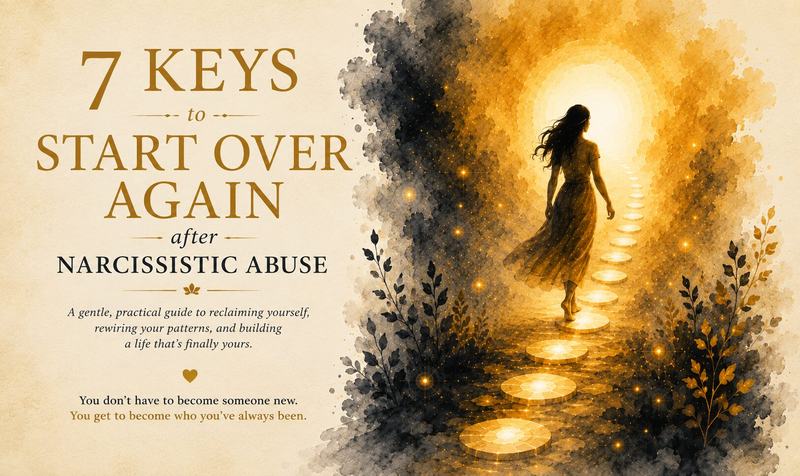 Free Guide From Kris Jobson
7 Keys to Start Over Again
After Narcissistic Abuse
A gentle, practical guide to reclaiming yourself and
trusting your own voice again
- 1. Unmask — See the pattern, not just the pain
- 2. Witness — Trust what your body already knew
- 3. Feel — Grieve what it cost you
- 4. Reclaim — Take back what you gave away, piece by piece
- 5. Trust — Give your own voice more weight than the doubt
- 6. Unhook — Release the hope that's still keeping you tied to them
- 7. Root — Ground the new pattern until it's who you are
- Create a new identity — not just a new mindset
Free. Instant access.
This Is Me — Show Me Where to Start
Before You Continue
One more thing. What has happened to you may have caught you off guard, but who you become from here onwards is entirely yours to choose. I'm glad you're here.Become the Safest Place You've Ever Known
21 Day Self-Worth Builder
21 Days to an Unshakeable, More Powerful You